Every wavelength you light for a single service is capacity left unmonetized. As metro, Data Center Interconnect (DCI), and long-haul traffic volumes grow, network planners face the same pressure: deliver more services over the same fiber without purchasing additional line cards, transponders, or dark fiber. A muxponder service card is the layer that solves this challenge. By aggregating multiple lower-rate client signals onto a single high-speed DWDM wavelength, it allows you to carry more services while significantly reducing transport spending.
The Cost of One Wavelength Per Service
In a traditional transponder-based design, each client service is allocated its own wavelength. While this model is simple, it does not scale efficiently: a 10×10G service plan consumes ten wavelengths, ten transponders, and ten line-side optics—while the capacity of the fiber itself remains vastly underutilized.
This inefficiency creates pain points in three primary areas:
1. Cost: Every added service multiplies the need for line cards and coherent optics, which are the most expensive components of an OTN/DWDM build.
2. Wavelength Exhaustion: C-band channels run out quickly, forcing premature investments in more complex and costly amplifier and ROADM infrastructures.
3. Operational Overhead: More standalone cards mean more rack space, higher power consumption, additional spare parts, and more management touchpoints.
For a network engineer, the math is uncomfortable: bandwidth demand rises steadily, but wavelength availability and capital budgets do not.
What Is a Muxponder Service Card?
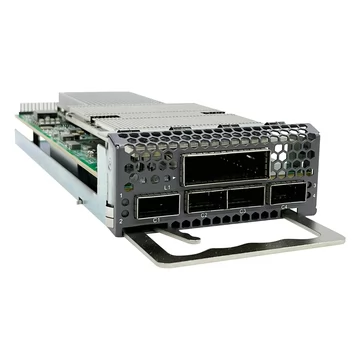
A muxponder service card is a pluggable OTN/DWDM line card that maps multiple lower-rate client signals into a single higher-rate wavelength using ITU-T G.709 (OTN) framing. It performs n:1 aggregation—for example, mapping 4×100G QSFP28 clients onto one 400G wavelength, or 20×10G SFP+ clients onto one 200G wavelength—and then hands that combined signal to the line-side optics for transport.
This is fundamentally distinct from a transponder, which maps one client signal to one wavelength (1:1). The true value of a muxponder lies in density and wavelength efficiency: one card and one wavelength can carry what would otherwise require several transponders and multiple wavelengths.
Key benefits at a glance:
· Wavelength efficiency: Consolidate multiple services onto a single DWDM channel instead of dedicating one channel per service.
· Lower cost per service: Reduce the required number of line cards, coherent optics, and rack space.
· Multi-rate flexibility: Mix 10G, 25G, and 100G Ethernet, Fibre Channel, and SONET/SDH clients on a single card.
· Standards-based interoperability: ITU-T G.709 OTN mapping and MSA-compliant optics ensure seamless integration with existing transport infrastructure.
Muxponder vs. Transponder: Which Fits Your Network?
The choice comes down to the volume of services you need to transport and whether you are optimizing for operational simplicity or maximum capacity. Here is how they compare across key factors:
· Mapping Architecture: A muxponder utilizes n:1 mapping, aggregating multiple client signals onto one wavelength. Conversely, a transponder uses 1:1 mapping, dedicating one client per wavelength.
· Best Use Cases: Muxponders are ideal for aggregating numerous lower-rate services to maximize fiber capacity. Transponders are better suited for a single service that requires simple wavelength conversion or 3R regeneration.
· Wavelength Utilization: While a muxponder uses a single wavelength to carry many distinct services, a transponder requires each service to occupy its own dedicated wavelength.
· Cost Trends at Scale: Muxponders deliver a progressively lower cost per service as network demands scale. Transponders, however, result in a higher cost per service at scale due to hardware duplication.
· Typical Client Mix: Muxponders are designed to handle a diverse mix of 10G, 25G, and 100G Ethernet, Fibre Channel, and SONET/SDH. Transponders typically handle single-rate or single-protocol links.
If you are building a metro ring with dozens of 10G and 100G services, a muxponder service card is usually the more economical choice. If you only need to extend one protected service across a long span, a transponder (OEO) card may be sufficient. Many robust networks utilize both: muxponders for aggregation and transponders for edge wavelength conversion.
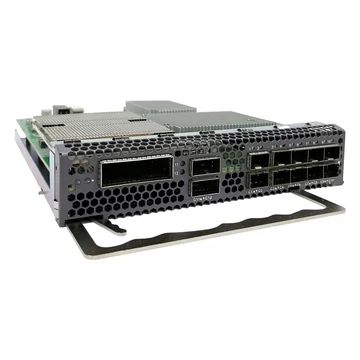
FiberMall Muxponder Service Card Lineup
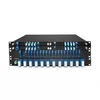
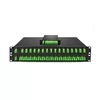
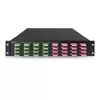
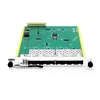
FiberMall offers six distinct muxponder service card configurations spanning 200G and 400G aggregation capacities, available in 1-slot and 2-slot form factors:
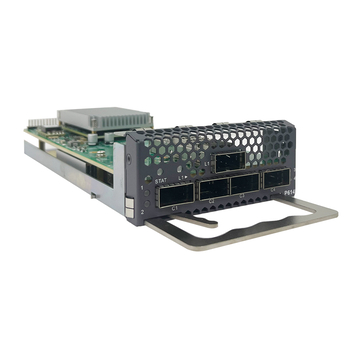
· 400G Muxponder Service Card (1-slot): Features 4×100G QSFP28 client interfaces mapped to 1×400G QSFP-DD line-side optics.
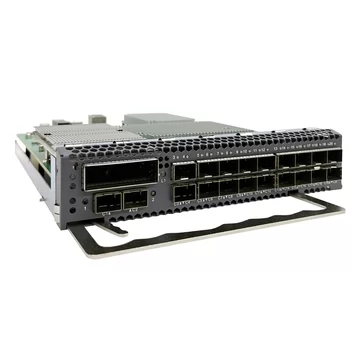
· 200G Muxponder Service Card (2-slot): Features 20×10G SFP+ client interfaces mapped to 1×200G CFP2 line-side optics.
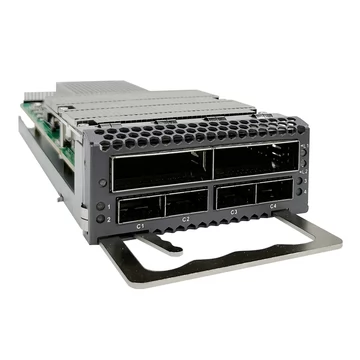
· 2×200G Muxponder Service Card (1-slot): Features 4×100G QSFP28 client interfaces mapped to 2×200G CFP2 line-side optics.
· 200G Muxponder Service Card (2-slot): Features 2×100G QSFP28 (or a flexible mix of 1×100G + 10×10G SFP+) client interfaces mapped to 1×200G CFP2 line-side optics.
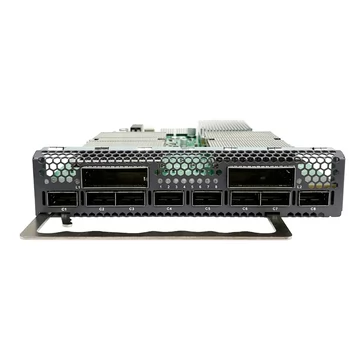
· 2×400G Muxponder Service Card (2-slot): Features 8×100G QSFP28 client interfaces mapped to 2×400G CFP2 line-side optics.
· 400G Muxponder Service Card (1-slot): Features 4×100G QSFP28 client interfaces mapped to 1×400G CFP2 line-side optics.
Features That Deliver
Multi-Rate Client Aggregation
The cards accept a dynamic mix of 10G SFP+, 25G SFP28, and 100G QSFP28 client interfaces. This allows a single card to consolidate Ethernet, Fibre Channel, and SONET/SDH services onto one wavelength. This flexibility means you do not need a separate card type for each service rate, significantly reducing spare inventory and simplifying network planning.
Coherent and Tunable Line-Side Optics
Line interfaces utilize CFP2, QSFP-DD, or pluggable coherent CFP2-DCO optics featuring tunable C-band DWDM wavelengths and Soft-Decision Forward Error Correction (SD-FEC). Coherent line optics support long-haul DWDM reaches—up to 1,000 km and beyond, depending on the specific module—extending the value of muxponders from short metro links directly into regional and long-haul transport.
Protection and Monitoring
Many configurations support 1+1 protection, Digital Diagnostics Monitoring (DDM), and hot-swappable operation. Coupled with SNMP, CLI, and web-based management interfaces for performance and alarm monitoring, operations teams can detect degrading optics before traffic drops and swap cards without causing service interruptions.
Standards-Based Compatibility
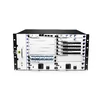
All cards strictly follow ITU-T G.709 OTN mapping and utilize MSA-compliant optics. They easily slot into a standard OTN main chassis alongside transponders, DWDM MUX/DEMUX units, and network management modules. This unified, one-vendor ecosystem eliminates the integration guesswork often associated with mixing cards from different suppliers.
Where Muxponder Service Cards Fit
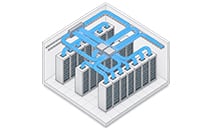
· Data Center Interconnect (DCI): Cloud and AI workloads demand massive bandwidth between facilities. A 2×400G card can aggregate eight 100G clients into two 400G wavelengths, maximizing fiber utilization between campuses.
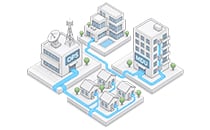
· Metro and Regional Networks: A 20×10G card consolidates twenty discrete 10G services onto a single 200G wavelength, freeing up valuable C-band channels for higher-priority traffic.
· Long-Haul Transport: Equipped with coherent CFP2-DCO line optics, muxponder cards can directly feed regional and long-haul DWDM spans without requiring a separate, dedicated transponder tier.
Frequently Asked Questions
What is a muxponder service card?
A muxponder service card is an OTN/DWDM line card that aggregates multiple lower-rate client signals (such as 10G or 100G) onto a single higher-rate wavelength using ITU-T G.709 framing. This drastically reduces the number of wavelengths and line cards a network requires.
What is the difference between a muxponder and a transponder?
A muxponder maps multiple client signals to one wavelength (n:1), whereas a transponder maps a single client to one wavelength (1:1). Muxponders are designed to maximize capacity and lower the per-service cost; transponders are typically used for wavelength conversion and 3R regeneration of standalone services.
What client signals can a FiberMall muxponder aggregate?
Configurations support 10G SFP+, 25G SFP28, and 100G QSFP28 clients. These can carry a wide variety of protocols, including 10GE, 100GE, OTU2/OTU4, Fibre Channel, and SONET/SDH services.
Do the cards support 1+1 protection?
Yes. Many FiberMall muxponder configurations support 1+1 protection alongside DDM monitoring and hot-swappable operation, ensuring high-availability transport for critical data.
Which line-side optics are compatible?
The cards use CFP2, QSFP-DD, or pluggable coherent CFP2-DCO optics. These feature tunable C-band DWDM wavelengths and SD-FEC, easily supporting transmission distances from metro networks out to long-haul reaches.
Can I use a FiberMall muxponder in my existing OTN chassis?
Yes. The cards adhere to ITU-T G.709 and MSA standards and are designed to slot directly into standard OTN chassis alongside FiberMall transponders, DWDM MUX/DEMUX hardware, and network management modules.