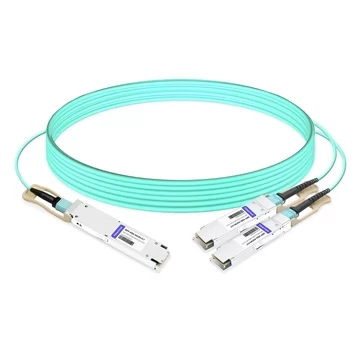
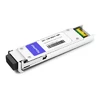
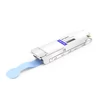
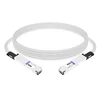
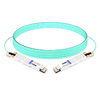
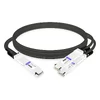
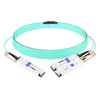
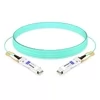
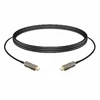
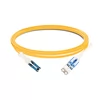
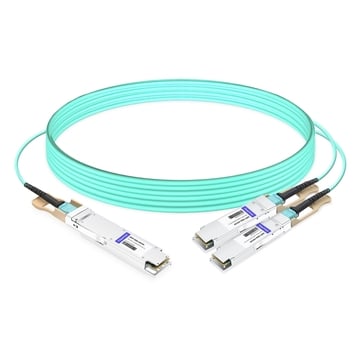
Upgrading to 400G Ethernet should not mean replacing every 100G or 200G device in your data center. A 400G breakout AOC lets you split one high-density 400G port into multiple lower-speed links, so you can protect existing infrastructure while scaling bandwidth.
The 400G Migration Problem
Moving from 100G/200G to 400G creates a connectivity gap. Your new switches may ship with QSFP-DD or OSFP ports, while your servers, storage arrays, and existing leaf switches may still use QSFP56 or QSFP28 interfaces. Replacing every endpoint with a new 400G NIC is expensive, disruptive, and often unnecessary.
Network architects face three consistent challenges:
Compatibility risk: A cable that works in one switch may fail in another because of vendor coding, firmware, breakout configuration, or host-side FEC requirements.
Distance limitations: Passive DAC is cost-effective but typically limited to short same-rack connections. Active Electrical Cables (AECs) extend reach slightly, but they are still copper-based and may not be ideal for inter-rack or row-to-row deployments.
Unexpected power and thermal load: A fully populated breakout deployment can add several hundred watts of transceiver and cable assembly power. In high-density 4×100G fan-out scenarios, total power can approach 1 kW depending on cable design and port count. This should be included in data center power and cooling planning.
The right 400G breakout AOC helps solve all three challenges. It extends reach up to 30 m or more, keeps cabling light and flexible, and connects directly to existing lower-speed ports when the host platform supports the required breakout mode.
FiberMall 400G Breakout AOC Solution
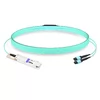
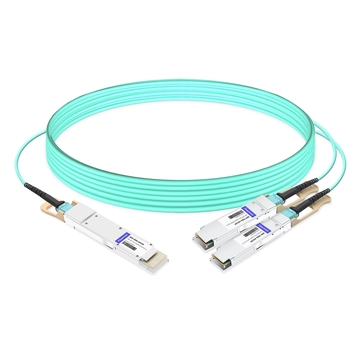
FiberMall 400G breakout AOC cables split a single 400G port into two 200G links or four 100G links using active optical engines and multimode fiber. Each cable can be coded and tested for interoperability with major switch and NIC platforms before shipment.
Key benefits:
Protect existing hardware — Connect 400G switches directly to 100G/200G endpoints without forklift upgrades.
Extend reach with lighter, more flexible cabling — Active optical signaling supports 1 m to 30 m+ runs, making it suitable for inter-rack and row-to-row cabling.
Reduce compatibility guesswork — Cables can be pre-coded and platform-tested for Dell, Cisco, H3C, Ruijie, Juniper, Arista, NVIDIA, and generic MSA hosts.
Deploy faster — Standard lengths, custom coding, and global inventory help reduce lead times from weeks to days for common configurations.
Available Configurations
FiberMall stocks common 400G breakout AOC configurations. Custom part numbers, lengths, and vendor coding are available on request.
For 400G to 2×200G connections, the 400G side can use QSFP-DD, and the fan-out side uses two QSFP56 connectors. The typical reach is 1 m to 30 m. This configuration is commonly used to connect a 400G switch port to dual 200G NICs, HCAs, or switch ports.
For 400G to 4×100G connections using QSFP56 fan-out, the 400G side can use QSFP-DD, and the fan-out side uses four QSFP56 connectors. The typical reach is 1 m to 30 m. This option is suitable for platforms that support 100G PAM4 or compatible 100G breakout modes.
For 400G to 4×100G connections using QSFP28 fan-out, the 400G side can use QSFP-DD, and the fan-out side uses four QSFP28 connectors. The typical reach is 1 m to 30 m. This configuration is designed for legacy 100G NRZ equipment migration. Because QSFP28 100G ports typically use 4×25G NRZ signaling, the cable assembly must include the required PAM4-to-NRZ gearbox/DSP functionality, and the host platform must support the required breakout mode.
For 400G to 2×200G connections in NVIDIA or AI cluster environments, the 400G side can use OSFP, and the fan-out side uses two QSFP56 connectors. The typical reach is 1 m to 30 m. This configuration is commonly used for NDR/HDR200-related fabric cabling, but the exact compatibility depends on the switch, NIC/HCA model, firmware, and breakout configuration.
Most configurations use parallel 50/125 µm multimode fiber and 850 nm VCSEL-based optical engines. Fiber count, lane mapping, and management interface vary by breakout type. For example, 400G SR8-style designs use 16 fibers, while other breakout designs may use different internal optical layouts. The 400G QSFP-DD or OSFP end typically uses CMIS management, while QSFP28 or QSFP56 fan-out ends may use SFF-8636 or CMIS depending on the module type and host platform.
Technical Specifications
The aggregate data rate is 400 Gb/s. In typical QSFP-DD or OSFP 400G designs, the 400G host-side interface uses eight 50 Gbps PAM4 electrical lanes, while the fan-out lane mapping varies by configuration.
The available form factors include QSFP-DD or OSFP on the 400G side, with QSFP56 or QSFP28 connectors on the fan-out side.
The fiber type is 50/125 µm multimode fiber, typically OM3 or OM4, depending on the required reach and cable design.
The operating wavelength is typically 850 nm for VCSEL-based multimode AOC designs.
Standard reach is 1 m to 30 m. Custom lengths up to 50 m or 100 m may be available on request, depending on the fiber type, cable architecture, connector configuration, and host platform.
Power consumption varies by configuration, gearbox/DSP design, and vendor coding. As a general product design target, the QSFP-DD or OSFP 400G end may consume up to 10 W, while each QSFP56 or QSFP28 fan-out end may consume up to 5 W. Exact power should be confirmed against the specific part number and host platform.
The operating temperature range is 0 °C to 70 °C for commercial-grade deployments.
Management support may include CMIS, SFF-8636, and DDM/DOM functions depending on the form factor and host-side requirements.
Applicable standards may include QSFP-DD MSA, OSFP MSA, IEEE 802.3bs, IEEE 802.3cd, IEEE 802.3cm, CMIS, SFF-8636, and RoHS. Standards compliance varies by configuration and host-side breakout mode.
Jacket options include LSZH or PVC.
400G Breakout AOC vs DAC vs AEC
Choosing the wrong cable type can limit reach, increase power, or force a redesign. Use the following guidance to match the cable type to your deployment scenario.
Passive DAC is the most cost-effective option for very short same-rack connections. It typically supports 1 m to 3 m, consumes little to no cable power, but is heavier and stiffer than optical cabling. It is best suited for top-of-rack connections where distance is short and cable density is manageable.
Active Electrical Cable, or AEC, is a copper-based cable with active signal conditioning. It typically supports around 3 m to 7 m, depending on speed, host platform, and cable design. AECs offer better signal performance than passive DACs, but they are still heavier than AOCs and may not be ideal for longer inter-rack runs.
Active Optical Cable, or AOC, is the best choice when reach, flexibility, and EMI immunity matter. AOC typically supports 1 m to 30 m or longer, uses lightweight optical fiber, and provides excellent immunity to electromagnetic interference. Power consumption is higher than passive DAC and varies by breakout configuration, but AOC is often the most reliable choice for inter-rack, row-to-row, and EMI-sensitive environments.
Rule of thumb: use DAC inside the rack, AEC between adjacent racks, and AOC between racks or rows. When your 400G links must cross aisles or run near power infrastructure, a breakout AOC is usually the more reliable choice.
When to Use 400G Breakout AOC
FiberMall customers deploy 400G breakout AOC cables in four primary scenarios.
Spine-Leaf Upgrades
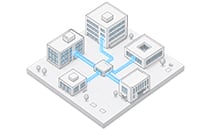
Modern spine or leaf switches may include 400G uplinks, while downstream servers, storage systems, or older leaf switches may remain at 100G or 200G. A 400G to 4×100G or 400G to 2×200G breakout AOC bridges the speed mismatch without replacing every endpoint.
AI and HPC Cluster Fabrics
Many NVIDIA NDR InfiniBand and high-speed Ethernet fabrics use OSFP or QSFP-DD-based 400G ports, depending on the exact switch and adapter model. OSFP-to-2×200G QSFP56 breakout AOCs can connect selected 400G platforms to existing 200G adapters, storage nodes, or fabric equipment. Compatibility should always be confirmed against the exact NVIDIA/Mellanox switch, NIC/HCA, firmware, and breakout configuration.
Legacy Migration
QSFP-DD to 4×QSFP28 breakout AOCs allow data centers to gradually retire 100G NRZ equipment while adding 400G capacity. For QSFP28 endpoints, the cable assembly must support the required PAM4-to-NRZ conversion, and the host platform must support the correct 4×100G breakout mode.
Hyperscale Row-to-Row Cabling
When racks are separated by aisles or walls, copper may not reliably carry high-speed 400G PAM4 signals over the required distance. AOCs provide the reach, signal integrity, flexibility, and EMI immunity needed for long-distance intra-data-center links.
OEM Compatibility Matrix
FiberMall 400G breakout AOCs can be coded and tested for the platform they will plug into. Select your vendor and target host platform to confirm the correct form factor, breakout mode, and part-number mapping.
For Dell platforms, common supported configurations include QSFP-DD to 2×QSFP56 breakout AOCs. A sample compatible part-number format is AOC-400G-Q56DD-200G2Q56-XXM.
For H3C platforms, common supported configurations include QSFP-DD to 2×QSFP56 breakout AOCs. A sample compatible part-number format is QSFPDD-400G-2QSFP56-200G-AOC-XXM.
For Ruijie platforms, common supported configurations include QSFP-DD to 2×QSFP56 breakout AOCs. A sample compatible part-number format is QDD-2Q56-AOCXXM.
For Cisco platforms, supported configurations may include QSFP-DD or OSFP to 2×QSFP56, and selected QSFP-DD or OSFP to 4×QSFP56 breakout options. Exact SKUs should be confirmed based on the switch model, operating system version, and breakout mode.
For Juniper platforms, supported configurations may include QSFP-DD or OSFP to 2×QSFP56, and selected QSFP-DD or OSFP to 4×QSFP56 breakout options. Exact SKUs should be confirmed based on the platform and port configuration.
For Arista platforms, supported configurations may include OSFP or QSFP-DD to 2×QSFP56 breakout AOCs. Exact SKUs should be confirmed based on the switch model, EOS version, and breakout requirements.
For NVIDIA platforms, supported configurations may include OSFP to 2×QSFP56 breakout AOCs for selected NDR/HDR200-related fabric deployments. Compatibility depends on the exact NVIDIA/Mellanox switch, NIC/HCA, firmware, and cable coding.
For generic MSA platforms, supported configurations may include QSFP-DD or OSFP to 2×QSFP56, and QSFP-DD or OSFP to 4×QSFP56 breakout AOCs. Standard MSA-coded versions are available for platforms that support MSA optics and the required breakout mode.
FAQ
What is a 400G breakout AOC, and how does it work?
A 400G breakout active optical cable takes one 400G port and splits it into multiple lower-speed ports using integrated optics and fiber. A typical QSFP-DD or OSFP 400G interface carries eight 50 Gbps PAM4 electrical lanes. The breakout cable divides those lanes into groups to create independent 2×200G or 4×100G links, depending on the cable architecture and host breakout mode.
What are the common 400G breakout configurations?
The most common configurations include QSFP-DD or OSFP 400G to 2×200G QSFP56, and QSFP-DD 400G to 4×100G QSFP56. QSFP-DD to 4×QSFP28 is also available for legacy 100G NRZ equipment, but it requires the appropriate PAM4-to-NRZ gearbox/DSP functionality and host-side breakout support.
What is the maximum reach of a 400G breakout AOC?
Standard FiberMall breakout AOCs support 1 m to 30 m. Custom lengths up to 50 m or 100 m may be available on request, depending on the fiber type, cable architecture, connector configuration, and host platform.
How much power does a 400G breakout AOC consume?
Power consumption depends on the cable architecture, gearbox/DSP design, vendor coding, and breakout configuration. As a general product design target, the QSFP-DD or OSFP 400G end may consume up to 10 W, while each QSFP56 or QSFP28 fan-out end may consume up to 5 W. Exact power should be confirmed against the specific part number and included in data center thermal planning.
Is QSFP-DD backward compatible with QSFP28?
QSFP-DD cages are mechanically designed to accept legacy QSFP-family modules such as QSFP56, QSFP28, and QSFP+ in many switch platforms. However, electrical operation, breakout mode, FEC, firmware support, and vendor coding still depend on the switch or NIC platform. A QSFP-DD module cannot be inserted into a QSFP28 or QSFP56 cage.
For QSFP-DD to 4×QSFP28 breakout applications, the cable assembly must support PAM4-to-NRZ conversion, and the host platform must support the required 4×100G breakout mode.
When should I choose AOC over DAC or AEC for 400G?
Choose AOC when reach exceeds short same-rack copper limits, when cabling must be lightweight and flexible, when EMI is a concern, or when connecting equipment across racks or rows. Use DAC for the lowest-cost same-rack links and AEC for short adjacent-rack runs where copper is still practical.
Do 400G breakout AOCs require FEC?
Most 400G PAM4 links rely on host-side FEC for stable operation. The required FEC mode depends on the switch, NIC/HCA, port speed, breakout mode, and cable type. Always check the host platform datasheet or configuration guide before deployment.
Which switch vendors are compatible with FiberMall 400G breakout AOCs?
FiberMall supports Dell, H3C, Ruijie, Cisco, Juniper, Arista, NVIDIA/Mellanox, and generic MSA platforms. Each cable can be coded and tested for the target vendor, switch model, port type, and breakout mode before shipment.