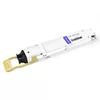
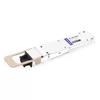
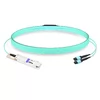
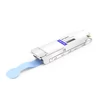
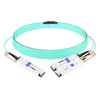
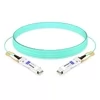
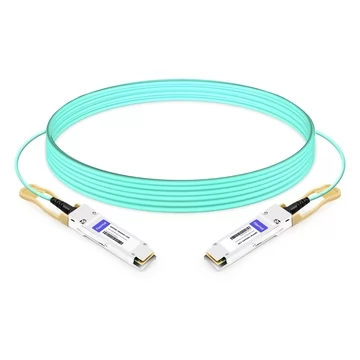
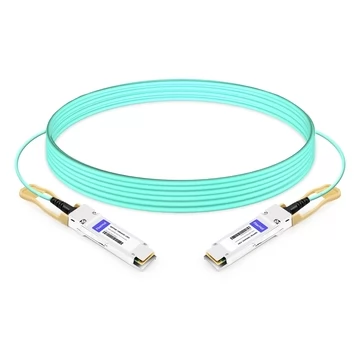
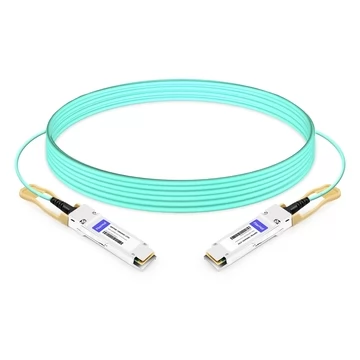
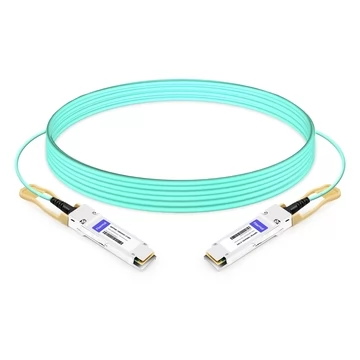
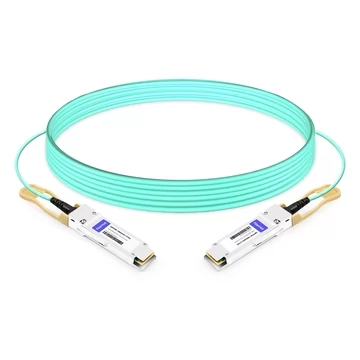
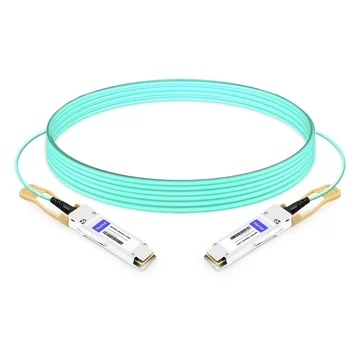
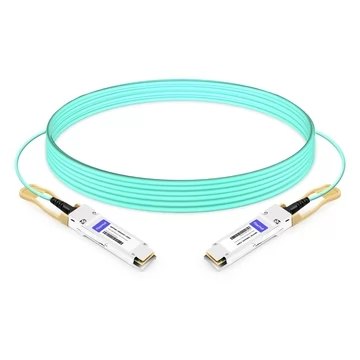
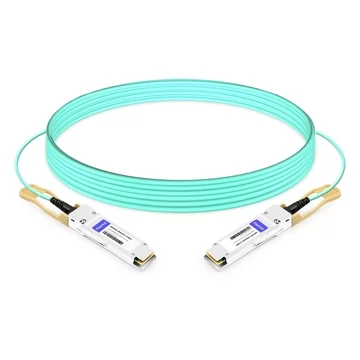
100G QSFP28 Immersion Cooling AOC: Reliable Optical Connectivity for Liquid-Cooled Data Centers
Standard 100G QSFP28 AOCs are generally designed and qualified for air-cooled environments. When an unqualified cable is submerged in dielectric coolant, its seals, adhesives, housing materials, cable jacket, and optical-path components may swell, soften, crack, leach, or otherwise degrade over time. The rate and severity of degradation depend on the coolant chemistry, operating temperature, exposure duration, and materials used in the cable assembly.
FiberMall 100G QSFP28 immersion cooling AOCs are designed for direct liquid-immersion applications. They are aligned with the Open Compute Project 100G QSFP28 SR4 Immersion Active Optical Cable requirements and can be validated against the specific switches, NICs, DPUs, and GPU server platforms used in your deployment.
Why Immersion Cooling Demands a Specialized 100G AOC
Liquid immersion cooling is moving from pilot projects into production environments. AI training clusters, high-density HPC systems, and sustainability-focused data centers are increasingly submerging servers and switches in dielectric fluids to support rack densities of tens of kilowatts and potentially reduce facility cooling overhead.
However, the interconnects installed inside immersion tanks must operate under conditions that standard air-cooled cables were not necessarily designed to withstand.
The three most common risks associated with using generic 100G AOCs in immersion environments are:
• Coolant exposure in the optical path: Seals, lens materials, and adhesives may swell, soften, crack, leach, or lose integrity when exposed to fluorochemical, hydrocarbon, synthetic ester, PAO, or silicone-based fluids.
• Material degradation over time: Housing plastics, cable jackets, labels, adhesives, and strain-relief components may experience dimensional changes or reduced mechanical strength after prolonged exposure at elevated temperatures.
• Interoperability uncertainty: Even when a cable remains physically stable in the coolant, it must still operate correctly with the target switch or network adapter without EEPROM, firmware, FEC, lane-mode, or port-configuration conflicts.
FiberMall addresses these risks by combining coolant-compatible construction with platform-specific compatibility validation. This approach reduces both material-compatibility and host-interoperability risks during deployment.
FiberMall 100G QSFP28 Immersion Cooling AOC Solution
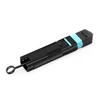
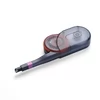
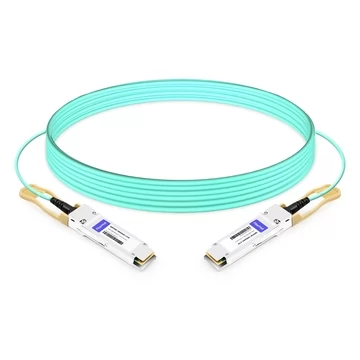
FiberMall 100G QSFP28 immersion cooling AOCs are active optical cable assemblies designed for direct submersion in qualified dielectric fluids.
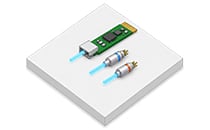
Each cable integrates a QSFP28 optical transceiver at both ends and converts the host electrical signals into optical signals within the assembly. This provides longer reach, lower cable weight, and immunity to electromagnetic interference compared with copper twinax cables. It also eliminates the need to install separate optical transceivers and external fiber patch cords inside the tank.
Compatibility with single-phase fluids must be validated against the exact coolant manufacturer, product formulation, operating temperature, and exposure conditions. Two-phase compatibility should only be claimed after additional fluid-specific material, extraction, thermal, and functional testing.
Key Benefits
• Alignment with the OCP 100G QSFP28 SR4 iAOC specification: The design follows applicable Open Compute Project requirements for electrical interfaces, optical performance, mechanical construction, and immersion-material compatibility.
• Coolant-compatible construction: Sealed optical assemblies, fluid-resistant housings, qualified adhesives, and immersion-compatible cable jackets are selected for prolonged dielectric-fluid exposure.
• Platform-specific compatibility testing: Cables can be validated on selected Arista, Cisco, H3C, Juniper, NVIDIA Networking, HPE, and Ruijie switches, NICs, and adapters before shipment.
• Custom lengths and EEPROM coding: Standard lengths are available from 3 m to 100 m, with additional lengths and single-vendor or dual-vendor EEPROM coding available upon request.
• Production and qualification reports: Unit-level production test data can be supplied with each shipment, while separate type-qualification reports document fluid compatibility and long-duration immersion testing.
Immersion AOC vs. Extender vs. DAC — Choose the Right Interconnect
Not every 100G link in an immersion-cooled data center requires the same interconnect solution. The appropriate choice depends on distance, cost, cable routing, whether active optical components may be submerged, and whether the transceiver must remain replaceable.
100G QSFP28 Immersion AOC
A 100G QSFP28 immersion AOC contains active optical components at both ends, and the complete assembly can be submerged in a validated dielectric coolant.
Typical assembly lengths range from 3 m to 100 m. It is best suited for medium-distance links within a tank, between adjacent tanks, or between immersed equipment and nearby infrastructure.
Because the optical engines and fiber are integrated into one sealed cable assembly, deployment is simpler than using separate transceivers and fiber patch cords. However, the transceivers cannot be replaced independently from the cable.
The fiber-based architecture provides immunity to electromagnetic interference.
Its relative cost is generally higher than a passive DAC but lower and simpler than some extender-plus-transceiver solutions.
QSFP28 Immersion Extender
An immersion extender relocates the usable QSFP28 interface from the submerged equipment to a dry area outside the tank. Depending on the product design, it may use a passive interface-extension structure or a sealed optical/electrical assembly.
The maximum distance is not unlimited. It is determined by the selected dry-side transceiver, fiber type, extender architecture, connector loss, and total optical or electrical link budget.
This option is best suited for longer-distance links, applications that require standard dry-side transceivers, or deployments where active optical modules should remain outside the coolant.
Its main advantage is flexibility. The dry-side transceiver can be replaced or upgraded independently, provided the extender and host platform support the new configuration.
100G QSFP28 DAC
A 100G QSFP28 DAC uses copper twinax cable and contains no optical conversion.
Passive DACs are typically used for distances of up to approximately 5 m. Active copper cables may support longer lengths, often up to approximately 10 m, depending on the cable design and host platform.
DACs are best suited for very short server-to-ToR or device-to-device links inside the same immersion tank. They generally provide the lowest cost and latency, but they are heavier and less flexible than optical cables.
Copper cables are shielded but remain more susceptible to electromagnetic interference than optical fiber. They also impose tighter bend-radius and cable-management requirements.
When to Choose a 100G QSFP28 Immersion AOC
Choose an immersion AOC when you need a sealed, integrated optical assembly that can be fully submerged and supports links between approximately 3 m and 100 m.
It is well suited to installations that prioritize simple deployment, low cable weight, EMI immunity, and factory-validated compatibility.
When to Choose an Immersion Extender
Choose an immersion extender when you need to use standard transceivers outside the tank, require a link distance determined by a specific dry-side optical standard, or want the flexibility to replace the external transceiver independently.
The exact extender architecture should be confirmed because passive interface extenders and active optical pigtails have different operating principles.
When to Choose an Immersion DAC
Choose an immersion DAC when the connection is very short, both endpoints are located in the same tank, and minimizing cost and latency is more important than cable weight, bend radius, or EMI immunity.
OCP Specification Alignment and Material Compatibility
The Open Compute Project 100G QSFP28 SR4 Immersion Active Optical Cable specification defines requirements for iAOCs used in immersion-cooled infrastructure.
The specification covers the mechanical form factor, host electrical interface, optical performance, management interface, operating conditions, and material compatibility of the cable assembly.
The module interface follows the QSFP28 mechanical requirements defined by SFF-8665, while module management is based on SFF-8636.
The optical interface is based on IEEE 802.3bm 100GBASE-SR4 performance requirements. A typical implementation uses 850 nm VCSEL transmitters and PIN photodiode receivers, although the exact optical architecture is product-specific.
Material compatibility must be evaluated using the actual coolant formulation. Applicable OCP test methods evaluate changes in material weight, length, diameter, appearance, and mechanical condition after prolonged fluid exposure. A commonly referenced acceptance criterion is less than 10% change in measured dimensions or weight, subject to the exact material and test requirement.
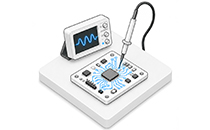
Thermal validation must confirm stable electrical and optical operation across the specified immersion-fluid temperature range. The OCP V0.1 operating-condition table references a case temperature from room temperature to 70 °C. Higher-temperature operation should only be stated when supported by product-specific validation.
Two-phase immersion systems may require additional extraction and compatibility testing beyond conventional immersion soak tests. Compatibility should therefore be confirmed with both the cable supplier and the coolant manufacturer.
FiberMall 100G QSFP28 Immersion Cooling AOC Specifications
The nominal Ethernet interface rate is 100 Gbps. The aggregate serial line rate is 103.125 Gbps, based on four electrical lanes operating at 25.78125 Gb/s NRZ.
The cable uses a QSFP28 connector at both ends.
It contains integrated multimode optical fiber. The internal fiber grade depends on the selected product configuration and cable length. The corresponding 100GBASE-SR4 reference limits are up to 70 m over OM3 fiber and up to 100 m over OM4 fiber.
The optical wavelength is approximately 850 nm. A typical FiberMall implementation uses a VCSEL transmitter and PIN photodiode receiver.
Standard assembly lengths include 3 m, 7 m, 10 m, 15 m, 30 m, 50 m, and 100 m. Additional lengths are available upon request.
The primary supported protocol is 100GBASE-SR4 Ethernet. InfiniBand EDR support is available on specifically validated configurations. Support for QDR, FDR, or other lower-rate modes requires a multi-rate cable design, compatible EEPROM programming, and host-platform validation.
The standard operating range for an OCP-aligned configuration is room temperature to 70 °C case temperature. Higher-temperature or industrial variants are subject to product-specific qualification.
For an OCP-aligned configuration, the target maximum power consumption is up to 2 W per cable end. Actual power depends on the cable length and product design and should be confirmed in the applicable SKU datasheet.
Digital diagnostics and module management are provided through the I²C interface in accordance with SFF-8636. Supported monitoring functions may include temperature, supply voltage, transmit bias, transmit optical power, receive optical power, alarms, and warning thresholds.
Applicable standards and certifications may include QSFP28 MSA requirements, IEEE 802.3bm, SFF-8665, SFF-8636, RoHS, CE, and FCC. Certification coverage should be confirmed for the exact product SKU and target market.
Switch, NIC, DPU, and GPU Server Compatibility
Compatibility is one of the most important considerations when purchasing third-party optical interconnects for production networks.
FiberMall addresses this requirement by validating its 100G QSFP28 immersion cooling AOCs on selected switches, network adapters, DPUs, and GPU server configurations.
Validation should be tied to the exact:
• Switch or adapter model
• Hardware revision
• Operating-system or firmware release
• Port speed and breakout mode
• FEC configuration
• EEPROM coding
• Cable length
• Test date
Selected test platforms may include:
• Arista 7060SX2-48YC6 and selected 7000-series switches
• Cisco Nexus N9K-C92160YC-X and supported ports on selected Nexus 9000 platforms
• Juniper QFX5110-48S-AFO and selected QFX-series switches
• NVIDIA Networking Spectrum switches and ConnectX adapters, including selected legacy Mellanox-branded platforms
• Selected H3C, HPE, and Ruijie data center switches
A general brand-level compatibility statement does not guarantee operation on every platform from that vendor. Customers should request a platform-specific compatibility matrix covering the exact hardware, firmware, port mode, and cable length used in the deployment.
Frequently Asked Questions
What Is a 100G QSFP28 Immersion Cooling AOC?
A 100G QSFP28 immersion cooling AOC is an active optical cable with integrated QSFP28 transceivers at both ends. It is designed and qualified to operate while submerged in a specified dielectric coolant.
It provides 100 Gbps optical connectivity between immersion-cooled switches, servers, NICs, DPUs, and GPU server platforms.
Can I Use a Standard 100G QSFP28 AOC in an Immersion Cooling Tank?
A standard AOC should not be used unless the exact cable has been qualified for the specific dielectric fluid, operating temperature, immersion method, and exposure duration.
Standard air-cooled AOCs are not necessarily manufactured with coolant-compatible seals, adhesives, cable jackets, or optical materials. They should therefore not be assumed to be suitable for immersion deployment.
What Is the OCP 100G QSFP28 SR4 Immersion AOC Specification?
The Open Compute Project specification defines the mechanical, electrical, optical, management, environmental, and material-compatibility requirements for 100G QSFP28 AOCs used in immersion cooling.
It references IEEE 802.3bm for 100GBASE-SR4 operation, SFF-8665 for the QSFP28 mechanical interface, and SFF-8636 for module management.
Which Dielectric Fluids Are Compatible with FiberMall Immersion Cooling AOCs?
Compatibility must be validated against the exact coolant manufacturer, product name, formulation, operating temperature, and immersion method.
Selected FiberMall configurations may be qualified for specified PAO-based, hydrocarbon-based, synthetic ester, silicone-based, PFPE-based, or fluorochemical coolant formulations. Compatibility with one formulation does not automatically establish compatibility with every fluid in the same chemical category.
Customers should provide the coolant manufacturer and exact product designation so that FiberMall can confirm whether fluid-specific validation data are available.
What Is the Difference Between an Immersion AOC, an Immersion Extender, and an Immersion DAC?
An immersion AOC is a sealed active optical cable assembly that contains integrated optical engines at both ends and can be fully submerged in a validated coolant.
An immersion extender relocates the usable transceiver or optical interface to a dry area outside the tank. The exact operating principle depends on whether the extender is passive, electrical, or optical.
An immersion DAC is a passive or active copper twinax cable designed for short links inside the tank. It offers lower cost and latency but has stricter cable-weight, bend-radius, reach, and EMI considerations.
Are FiberMall 100G QSFP28 Immersion AOCs Compatible with Cisco, Arista, Juniper, and NVIDIA Networking Platforms?
FiberMall immersion AOCs can be coded and tested for selected Cisco, Arista, Juniper, H3C, NVIDIA Networking, HPE, and Ruijie platforms.
Compatibility is model- and firmware-specific. Customers should provide the exact switch, NIC, or DPU part number, software version, port configuration, and required cable length before ordering.
Custom EEPROM coding can help ensure correct module recognition, but EEPROM coding alone does not guarantee compatibility. Host lane rate, FEC, power class, firmware, and port mode must also be supported.
Does FiberMall Provide Test Reports for Immersion Cooling AOCs?
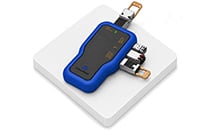
Yes. Unit-level production test reports can be provided with each shipment.
Depending on the product and order requirements, these reports may include:
• Bit-error-rate testing
• Link establishment
• EEPROM verification
• Supply current and power measurements
• Optical transmit and receive parameters
• Alarm and warning thresholds
• Visual and mechanical inspection
Separate type-qualification reports may include:
• Long-duration fluid exposure
• High-temperature immersion testing
• Weight and dimensional changes
• Material extraction or leaching evaluation
• Post-immersion optical and electrical testing
• Cable-jacket and housing inspection
Routine production testing should not be confused with long-duration material-compatibility qualification. The latter is normally performed by product type and coolant formulation rather than on every individual cable shipped.
What Lengths Are Available for 100G QSFP28 Immersion Cooling AOCs?
Standard lengths include 3 m, 7 m, 10 m, 15 m, 30 m, 50 m, and 100 m.
Custom lengths are available upon request. Maximum supported length depends on the internal fiber grade, optical design, target platform, coolant environment, and qualification status.