


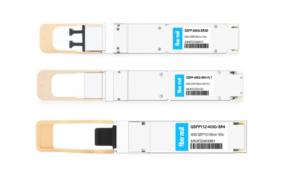
800G SR8 and 400G SR4 Optical Transceiver Modules Compatibility and Interconnection Test Report
Version Change Log Writer V0 Sample Test Cassie Test Purpose Test Objects:800G OSFP SR8/400G OSFP SR4/400G Q112 SR4. By conducting corresponding tests, the test parameters meet the relevant industry standards,

USFP Thermal Design: 100W Power Dissipation Without Embedded Cooling
The USFP thermal design is intended to support up to 100W of power dissipation per module without a dedicated embedded cooling circuit. In a host-cooled implementation, heat can be transferred
DWDM Amplifier Guide: EDFA Types, Specs & Selection
Dmitri ordered six amplifiers for a metro build. All were C-band, specified for a 40-channel configuration, and listed as boosters. Two had 17 dB of gain and a listed “saturated

USFP AI Factory Networking: How 400G/Lane Optics Reshape the AI Fabric
USFP (Ultra-Dense Small Form Factor Pluggable) is the new optical transceiver form factor from NVIDIA and Cisco that brings 400 Gb/s-per-lane electrical signaling to AI factory networking. Announced at OCP Global

DWDM Network Design: Link Budget & Planning Guide
A 40-wavelength link on a 100 GHz grid ran cleanly for two years. Then the team expanded it to 96 wavelengths on a 50 GHz grid, and channels near the

1.6T and 3.2T Optical Transceivers: The Next-Gen Speed Guide for AI Data Centers
1.6T optical transceivers are emerging as the next step in high-speed connectivity for AI data centers, while 3.2T remains an early-stage technology direction. For hyperscale computing clusters, these architectures can

USFP vs XPO vs OSFP-XD: The Next-Gen Pluggable Form Factor War
USFP, XPO, and OSFP-XD are three next-generation pluggable optical form factors designed to address growing bandwidth demands in AI networks, from 1.6T and 3.2T to 12.8T and beyond. The short