


Active Copper Breakout Cables are cables that connect a single high-speed port to multiple lower-speed ports. They are typically used to connect switches, servers, and storage devices in data centers. They use copper wires to transmit electrical signals and have active components in the connectors that boost the signal quality and extend the reach. They can support data rates from 10G to 400G per lane.
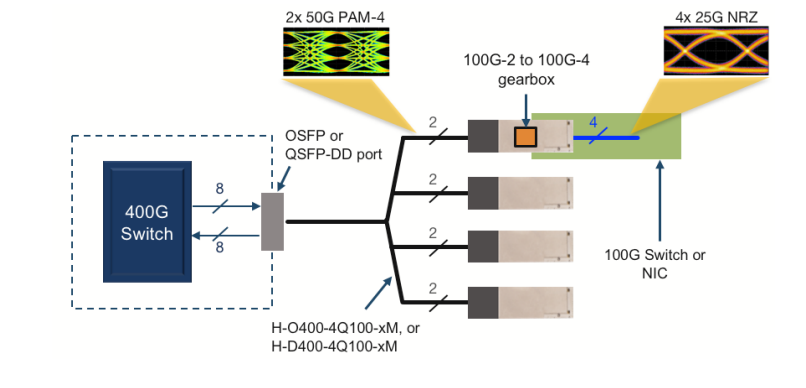
The QSFP end of the active breakout cable includes a gearbox chip which converts 2x 50G PAM-4 electrical signals from the 400G port (a 100G-2 interface) into 4x 25G NRZ electrical signals (a 100G-4 interface). The vast majority of the installed base of 100G QSFP switches / routers / NICs use 100G-4 QSFP ports (where the QSFP port has an electrical interface consisting of 4x 25G NRZ electrical signals).
The Arista active copper breakout cables offer a cost-effective way to breakout a 400G port into 4x100G and connect to an installed base of 100G QSFP ports.
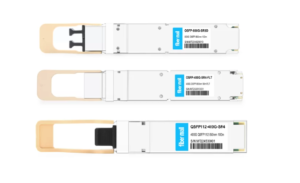
800G SR8 and 400G SR4 Optical Transceiver Modules Compatibility and Interconnection Test Report
Version Change Log Writer V0 Sample Test Cassie Test Purpose Test Objects:800G OSFP SR8/400G OSFP SR4/400G Q112 SR4. By conducting corresponding tests, the test parameters meet the relevant industry standards, and the test modules can be normally used for Nvidia (Mellanox) MQM9790 switch, Nvidia (Mellanox) ConnectX-7 network card and Nvidia (Mellanox) BlueField-3, laying a foundation for
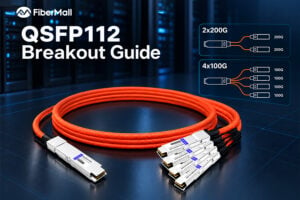
QSFP112 Breakout Guide: 400G to 2x200G and 4x100G
A 400G QSFP112 port looks straightforward: four high-speed electrical lanes combine to deliver one 400G interface. Breakout seems equally simple—divide those lanes into two 200G links or four 100G links. In practice, however, the cable is only one part of the design. A successful QSFP112 breakout depends on the switch
QSFP112 Price Guide 2026: 400G Module Costs, Cost Per Port and Volume Tiering
The same 400G DR4 optic can sell for around $500 from a factory-direct supplier and more than $1,400 from some vendor list price channels. Four price points, one standard, and four identical 500-meter links. That spread is the challenge when searching for a QSFP112 price. Google returns a long list
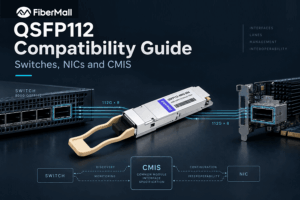
QSFP112 Compatibility Guide: Switches, NICs and CMIS
Priya spent most of a Tuesday morning troubleshooting a link that should have taken four minutes to bring up. She inserted a 400G QSFP112 module into an older leaf switch with a compatible-looking QSFP cage, watched the switch inventory recognize the module, and waited for the port status to turn

QSFP112 Module Types: VR4, SR4, DR4, FR4 and LR4 Compared
Send a request for “a 400G QSFP112 module” to three different vendors and you may receive three different recommendations. One vendor may quote a DR4. Another may suggest a DR4+. A third may ask about your installed fiber infrastructure and explain that neither option matches your deployment requirements. That is not
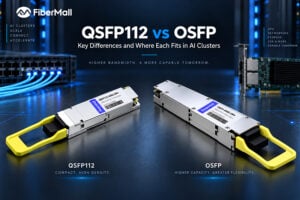
QSFP112 vs OSFP: Choosing the Right 400G Form Factor
At first glance, QSFP112 and OSFP look like two competing form factors for high-speed networking. Both appear in 400G systems, both support PAM4 signaling, and both are widely used in AI and HPC infrastructure. But treating this as a simple “QSFP112 or OSFP?” decision misses the bigger picture. The right
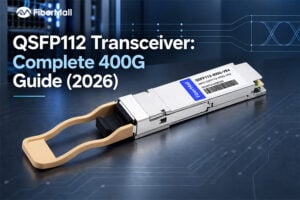
QSFP112 Transceiver: Complete 400G Guide (2026)
Ask five network engineers whether they should deploy QSFP112 or QSFP-DD for a 400G network, and you may get five different answers. Both form factors can support 400G, both are widely available, and both have legitimate advantages depending on the platform. The right choice depends on your switch or NIC