


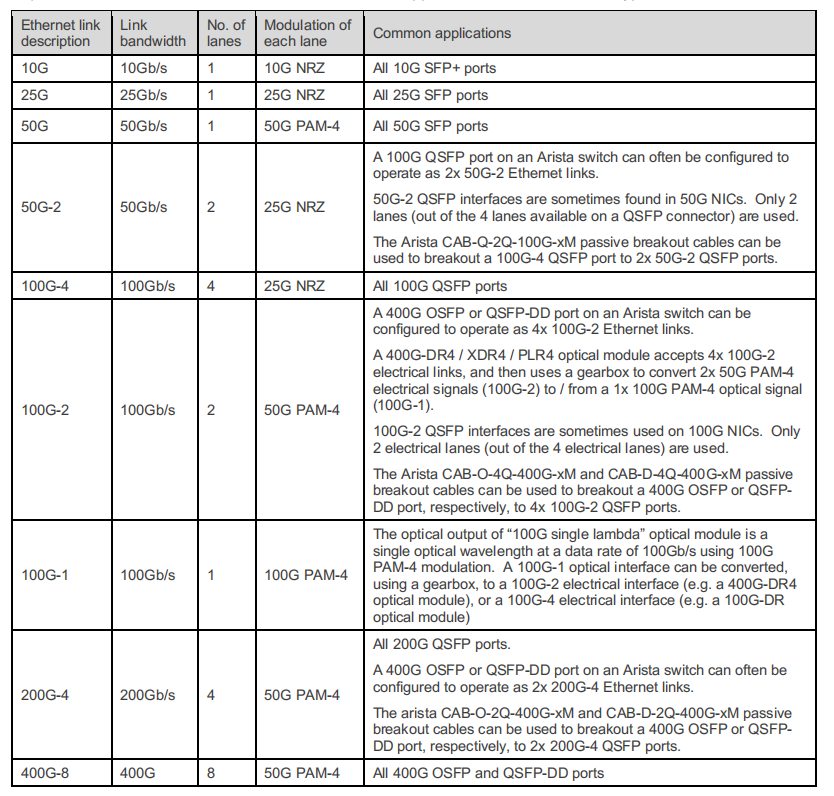
The terms 100G-2, 100G-4, 50G-2, 200G-4 and 400G-8 are abbreviations for different types of Ethernet interfaces that use different numbers of lanes and different modulation schemes to achieve different data rates. The general format is XG-Y, where X is the data rate in gigabits per second (Gbps), and Y is the number of lanes or the modulation scheme used.
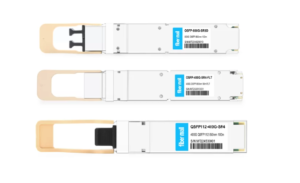
800G SR8 and 400G SR4 Optical Transceiver Modules Compatibility and Interconnection Test Report
Version Change Log Writer V0 Sample Test Cassie Test Purpose Test Objects:800G OSFP SR8/400G OSFP SR4/400G Q112 SR4. By conducting corresponding tests, the test parameters meet the relevant industry standards, and the test modules can be normally used for Nvidia (Mellanox) MQM9790 switch, Nvidia (Mellanox) ConnectX-7 network card and Nvidia (Mellanox) BlueField-3, laying a foundation for

1.6T and 3.2T Optical Transceivers: The Next-Gen Speed Guide for AI Data Centers
1.6T optical transceivers are emerging as the next step in high-speed connectivity for AI data centers, while 3.2T remains an early-stage technology direction. For hyperscale computing clusters, these architectures can increase bandwidth per port and support continued network scaling. Actual latency and energy-efficiency benefits depend on the transceiver design, host

USFP vs XPO vs OSFP-XD: The Next-Gen Pluggable Form Factor War
USFP, XPO, and OSFP-XD are three next-generation pluggable optical form factors designed to address growing bandwidth demands in AI networks, from 1.6T and 3.2T to 12.8T and beyond. The short answer: OSFP-XD has commercially listed 1.6T modules, XPO is being developed as a high-density, liquid-cooled solution with commercial deployment anticipated
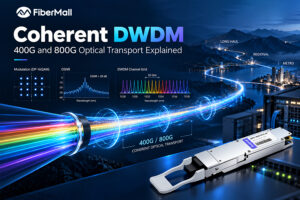
Coherent DWDM: 400G and 800G Optical Transport Explained
Consider an illustrative 640 km regional route between two carrier hotels. Rafael’s team needs a fourfold capacity increase, and a proposal promises that moving from 400G to 800G per wavelength will deliver it. The optical modules may be capable of 800G, but the grid tells a different story. Under the

4-Node DGX Spark Cluster Setup: From Hardware BOM and Cabling to First Boot and 200G Interconnect
Building a 4-node NVIDIA DGX Spark cluster involves more than simply connecting four powerful AI systems. The real challenges often lie in the details: a machine without native USB-A ports, a switch port that refuses to establish a link, or a firmware update that fails unexpectedly and requires system recovery. This

USFP vs CPO: Pluggable vs Co-Packaged Optics Compared
USFP vs CPO is a choice between two ways to move data inside an AI data center. USFP (Ultra-Dense Small Form Factor Pluggable) is a pluggable 400G-per-lane optical module you can swap in the field. CPO (co-packaged optics) integrates the optical engine directly into the switch chip to save power, at the
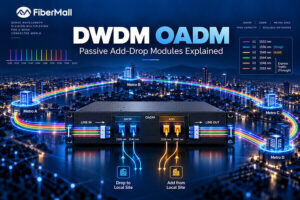
DWDM OADM: Passive Add-Drop Modules Explained
Every DWDM OADM a wavelength passes through introduces some optical loss. Across five cascaded nodes, that loss can consume a substantial share of the link budget—potentially comparable to tens of kilometers of fiber, depending on the OADM design. That is a detail an initial network plan can easily overlook. It