
Marcus stared at the switch datasheet. His team had just finished qualifying 800G optics, and now procurement was asking about 1.6T. Same rack, same power budget, same question every generation asks: which form factor wins?
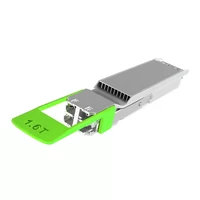
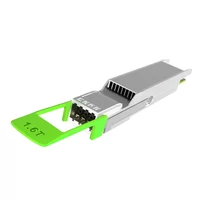
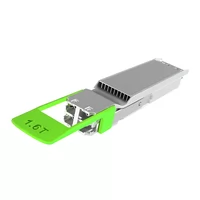
The 1.6T QSFP roadmap isn’t a single track; it’s a fork. One path keeps the QSFP family alive with QSFP-DD1600, while the other widens the module to OSFP1600 and its extended-density sibling, OSFP-XD.
Both deliver 1.6 Tbps. Same bandwidth. They disagree on thermal headroom, backward compatibility, and port density.
This guide maps the 1.6T optical transceiver landscape for network architects, procurement teams, and NOC engineers. You’ll learn how 200G PAM4 lanes make 1.6T possible, when standards like IEEE 802.3dj land, and how to choose between QSFP-DD1600 and OSFP1600 for your next deployment.

Why 1.6T Optical Modules Are Happening Now
AI training clusters rewrote the bandwidth rules, and a single 102.4T switch ASIC can push more bits than an entire top-of-rack row from five years ago. At those speeds, the gap between switch capacity and optical capacity becomes the bottleneck. Bottlenecks cost money.
800G optics are already in high-volume production, and the 800G QSFP-DD migration guide covers that generation in depth. The step to 1.6T follows the same pattern: double the lane rate, keep the pluggable form factor, and push the optics closer to the switch. The lane rate in question is 200 Gbps PAM4, up from the 100 Gbps PAM4 that most 800G modules use today.
Switch ASICs tell the story. 51.2T switches drive 800G. The next generation, 102.4T and beyond, needs 1.6T front-panel optics to make the math work.
Without them, switch bandwidth becomes theoretical. Hyperscalers began 1.6T trials in 2025. Mass production is the story of 2026 and 2027.
Data centers also care about faceplate density. A 1.6T port in a QSFP-DD footprint keeps existing switches useful. That density matters when every rack slot has its own power and cooling price tag.
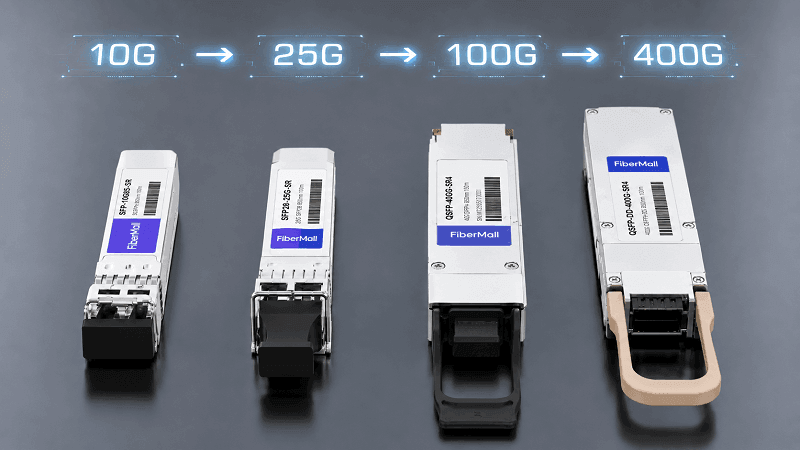
The QSFP Family Evolution
The QSFP form factor has stretched across four speed generations without changing its core promise: hot-pluggable, high-density, multi-vendor compatible.
- QSFP28: 4 × 28 Gbps NRZ lanes, 100 Gbps total.
- QSFP-DD: 8 × 50 Gbps PAM4 lanes, 400 Gbps total.
- QSFP-DD800: 8 × 100 Gbps PAM4 lanes, 800 Gbps total.
- QSFP-DD1600: 8 × 200 Gbps PAM4 lanes, 1.6 Tbps total.
The QSFP transceiver family has always prioritized backward compatibility. A QSFP-DD1600 cage accepts a QSFP-DD800, a QSFP-DD 400G, or even a QSFP28 module. That’s the investment protection that keeps many data center operators on the QSFP path.
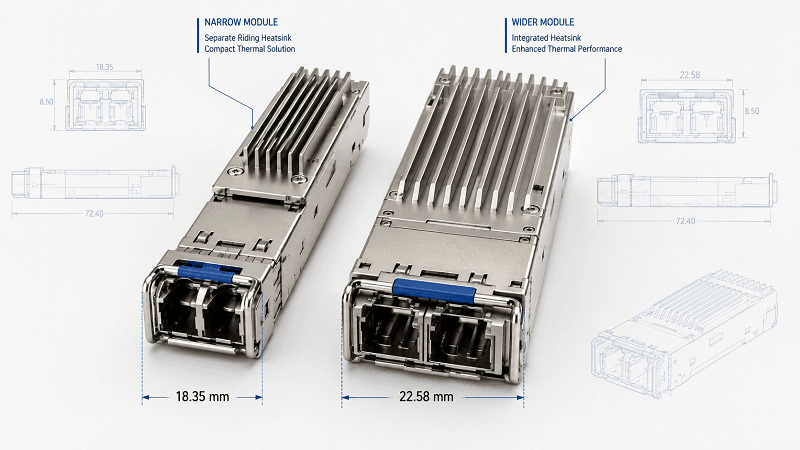
The mechanical envelope stays the same. The QSFP-DD form factor keeps the familiar 18.35 mm width. What changes is the electrical interface, the thermal design, and the management data model hiding underneath.
QSFP-DD1600: Specification Deep Dive
The QSFP-DD MSA published the hardware specification that defines QSFP-DD1600 in Revision 7.0, announced at ECOC 2023. Revision 7.1, released in June 2024, refines the module and connector definitions.
The headline numbers are straightforward:
| Parameter | QSFP-DD1600 Value |
| Aggregate bandwidth | 1.6 Tbps |
| Electrical lanes | 8 × 200 Gbps PAM4 |
| Form factor width | 18.35 mm |
| Backward compatibility | QSFP-DD800, QSFP-DD, QSFP56, QSFP28 |
| Typical power envelope | 20–28 W |
| Thermal solution | Riding heatsink + host airflow |
| Management interface | CMIS 5.x |
The riding heatsink is worth a closer look. At 1.6T, the module packs twice the power density of 800G into the same width. That’s a lot of heat in a small space.
The heatsink rides on top of the module and depends on the switch’s airflow. Chassis design matters more at 1.6T than it did at 400G.
Backward compatibility is the strongest argument for QSFP-DD1600. An operator can install a 1.6T-capable switch today, run 400G or 800G optics until demand justifies the upgrade, and then swap in 1.6T modules without changing the cage. That’s how the migration lowers risk.
OSFP 1.6T and OSFP-XD
OSFP takes a different bet. It gives up some density for thermal margin. Width buys cooling.
OSFP1600 uses the same OSFP envelope as OSFP800 and OSFP400G. It’s wider than QSFP-DD, about 22.58 mm, and carries an integrated heatsink rather than relying solely on a riding heatsink.
The extra metal and surface area help dissipate heat. That matters when modules push toward 30 W, 35 W, or higher.
The trade-off is clear. OSFP1600 offers better thermal headroom but doesn’t have compatibility with QSFP modules. If your switches have OSFP cages, you’re already on the OSFP train. If they have QSFP-DD cages, OSFP1600 isn’t an option.
OSFP-XD adds another wrinkle. The “XD” stands for eXtended Density. It’s physically larger than standard OSFP and supports up to 16 electrical lanes.
Some hyperscalers reportedly specified OSFP-XD in a majority of 2025 contracts for AI clusters. OSFP-XD isn’t interchangeable with standard OSFP cages, but it creates a clean path toward future 3.2T modules.
For coherent 1.6T modules like 1600ZR+, OSFP1600 or OSFP-XD are the more practical homes. Coherent pluggables need more DSP power and more thermal budget than direct-detect modules. QSFP-DD1600 can handle lower-power 1.6T variants, but the highest-power coherent variants gravitate toward OSFP.
QSFP-DD1600 vs. OSFP1600: Head-to-Head
| Feature | QSFP-DD1600 | OSFP1600 |
| Aggregate bandwidth | 1.6 Tbps | 1.6 Tbps |
| Electrical interface | 8 × 200G PAM4 | 8 × 200G PAM4 |
| Width | ~18.35 mm | ~22.58 mm |
| Backward compatibility | QSFP-DD, QSFP28 family | OSFP800/400G only |
| Power envelope | ~20–28 W | ~25–40 W+ |
| Thermal design | Riding heatsink | Integrated heatsink |
| Port density | Higher | Lower |
| Best fit | Legacy QSFP upgrades, density-first designs | High-power coherent, AI/HPC clusters |
The full QSFP-DD vs OSFP comparison explains the 400G and 800G roots of this split. At 1.6T, the same logic applies.
Choose QSFP-DD1600 when you want maximum port density, the ability to reuse existing QSFP modules, and a lower-power direct-detect deployment. Choose OSFP1600 when thermal headroom matters more than density, when you’re deploying high-power coherent optics, or when your switch platform is already OSFP-native.
There isn’t a universal winner. There’s only the right fit for the switch generation and the thermal budget.
The 200G PAM4 Lane Revolution
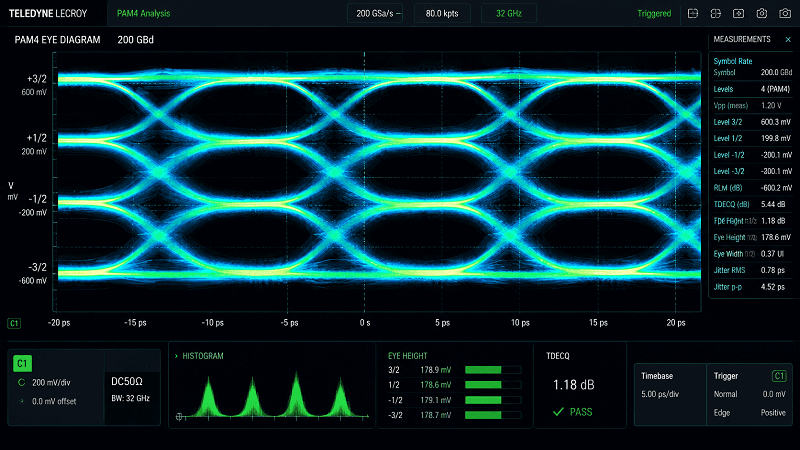
Every speed jump in pluggable optics has come from increasing lane rate. 1.6T moves from 100G PAM4 to 200G PAM4 electrical signaling. Higher symbols, harder signals.
PAM4 encodes two bits per symbol, so it runs at half the baud rate of NRZ for the same bit rate. That’s why PAM4 dominates high-speed interconnects. But 200G PAM4 pushes signal integrity to its limits. PCB traces, connectors, and package substrates all become part of the design problem.
The CEI-224G electrical interface from OIF defines the 224 Gbps lane signaling that underpins 200G PAM4, while IEEE 802.3dj defines 1.6 Tb/s Ethernet itself. These standards must settle before the ecosystem can fully converge.
DSPs are critical. A 1.6T module isn’t just a laser and a photodetector; it’s a signal-processing engine that compensates for channel loss, crosstalk, and nonlinearity. Silicon photonics plays a growing role here, with market share expected to climb from roughly 40–45% at 800G to around 60% at 1.6T.
1.6T QSFP Roadmap Timeline: 2024–2027+
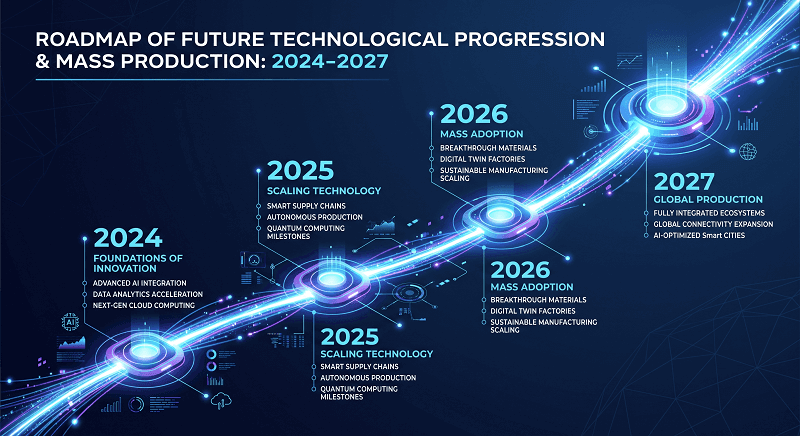
This 1.6T QSFP roadmap follows a predictable cadence: specs first, sampling second, production third.
| Year | Milestone |
| 2023 | QSFP-DD MSA Rev 7.0 introduces QSFP-DD1600 at ECOC. |
| 2024 | Rev 7.1 published; early sampling and interoperability testing. |
| 2025 | Hyperscaler trials; low-volume production; OSFP-XD wins early AI contracts. |
| 2026 | Mass-production inflection; 1.6T begins displacing 800G in high-end clusters. |
| 2026–2027 | IEEE 802.3dj targeted for ratification; broader commercial adoption. |
| 2027+ | Mainstream 1.6T; pivot toward 3.2T and co-packaged optics (CPO). |
IEEE 802.3dj is the standard to watch. It defines 1.6 Tb/s Ethernet using 200 Gb/s lanes. Public IEEE documents show the draft in ballot and recirculation through 2026, with ratification targeted for submission around August 2026. Until ratification, early 1.6T products follow pre-standard implementations and MSA specifications.
Pricing will follow the usual curve. Early 1.6T modules are landing around 1,300-1,500 today. Within two years, expect that to fall toward $1,100 as volume ramps and yields improve. Volume wins.
Standards and Management Ecosystem
Pluggable optics don’t work without management. At 1.6T, the Common Management Interface Specification (CMIS) is the interface the host uses to read module state, configure lanes, and monitor alarms.
CMIS for QSFP modules is already familiar to engineers running QSFP-DD. At 1.6T, CMIS 5.x handles the larger lane count, the more complex state machine, and the richer diagnostic data. VDM, Versatile Diagnostic Monitoring, adds FEC statistics and per-lane quality metrics that matter when you’re debugging 200G PAM4 links.
Beyond IEEE 802.3dj and CMIS, the ecosystem includes:
- QSFP-DD MSA: mechanical and electrical specs for QSFP-DD1600.
- OSFP MSA: mechanical and electrical specs for OSFP1600.
- OIF 1600ZR/ZR+: implementation agreements for coherent 1.6T pluggables.
- CEI-224G: the electrical lane standard feeding both form factors.
Power, Thermal, and Cabling Considerations
Power is the hidden architect of the 1.6T roadmap. QSFP power consumption per gigabit has climbed with every generation, and 1.6T continues the trend.
A QSFP-DD1600 direct-detect module may draw 20–28 W. An OSFP1600 coherent module can exceed 35 W. Multiply that by 32 or 64 ports per switch, and the thermal load becomes a rack-level design problem. Every watt counts.
Cabling choices also shift:
- DAC/AOC: still viable for very short reaches, but power and signal integrity limits tighten at 200G/lane.
- Active optical cables (AOC): popular for switch-to-switch links inside a cluster.
- Fiber pairs: 1.6T DR8 uses eight pairs; newer 400G-per-lambda designs like 1.6T DR4 cut that to four pairs.
Data center cooling has to keep up. A faceplate full of 1.6T modules moves more heat per square inch than any previous pluggable generation. Airflow, heatsink design, and rack layout all become part of the optical specification.
What the 1.6T QSFP Roadmap Means for Network Architects
If you’re planning a 2026 or 2027 refresh, start qualification now. 1.6T isn’t a future technology; it’s a current procurement decision.
A practical decision framework:
1. Check your switch cages. QSFP-DD1600 only fits QSFP-DD cages. OSFP1600 only fits OSFP cages. The form factor is often decided by the switch vendor before you pick an optic.
2. Map your reach and power. Short-reach direct-detect links favor QSFP-DD1600. Long-reach coherent links favor OSFP1600 or OSFP-XD.
3. Plan backward compatibility. QSFP-DD1600 protects existing module inventory. OSFP1600 doesn’t.
4. Budget thermals. Power per port climbs. Make sure your cooling can handle the densest configuration.
5. Track standards. IEEE 802.3dj ratification will reduce interoperability risk.
FiberMall designs fiber optic transceivers across the QSFP family. If your team is evaluating a 1.6T optical transceiver purchase, our engineering team can help match form factor, reach, and power budget to your switch platform.
Conclusion
The 1.6T QSFP roadmap splits into two practical paths. QSFP-DD1600 preserves the QSFP family’s density and backward compatibility. OSFP1600 trades density for thermal headroom and high-power coherent support. Both rely on 200G PAM4 lanes and both depend on IEEE 802.3dj and CMIS 5.x for a stable ecosystem.
For most data center operators, the choice is already half-made by the switch vendor. The job now is to understand the trade-offs, plan the migration, and qualify early enough to avoid a bandwidth bottleneck. Start early.
Here are the key takeaways:
- 1.6T uses 8 × 200G PAM4 lanes to reach 1.6 Tbps.
- QSFP-DD1600 keeps the QSFP form factor and backward compatibility.
- OSFP1600 offers more thermal headroom for high-power modules.
- 2026 is the mass-production inflection year; 2026–2027 is the standards ratification window.
- Power and cooling are now primary design constraints at 1.6T.
Need help selecting the right 1.6T optical transceiver for your next deployment? Contact the FiberMall networking team for a compatibility review and quote.
Related Products:
-
 OSFP-1.6T-DR8D+ 1.6T OSFP DR8D+ PAM4 1311nm 2km Dual MPO-12 SMF Optical Transceiver Module
$3500.00
OSFP-1.6T-DR8D+ 1.6T OSFP DR8D+ PAM4 1311nm 2km Dual MPO-12 SMF Optical Transceiver Module
$3500.00
-
OSFP-1.6T-DR8+ 1.6T OSFP DR8+ PAM4 1311nm 2km MPO-16 SMF Optical Transceiver Module
$3000.00
-
OSFP-1.6T-DR8D 1.6T 2 x DR4/DR8 OSFP224 PAM4 1311nm 500m Dual MPO-12 SMF Optical Transceiver Module
$1500.00
-
OSFP-1.6T-DR8 1.6T 2 x DR4/DR8 OSFP224 PAM4 1311nm 500m MPO-16 SMF Optical Transceiver Module
$3000.00
-
OSFP-XD-1.6T-4FR2 1.6T OSFP-XD 4xFR2 PAM4 1291/1311nm 2km SN SMF Optical Transceiver Module
$5000.00
-
OSFP-XD-1.6T-2FR4 1.6T OSFP-XD 2xFR4 PAM4 2x CWDM4 2km Dual Duplex LC SMF Optical Transceiver Module
$5000.00
-
OSFP-XD-1.6T-DR8 1.6T OSFP-XD DR8 PAM4 1311nm 2km MPO-16 SMF Optical Transceiver Module
$4500.00
-
NVIDIA MMS4A00 (980-9IAH1-00XM00) Compatible 1.6T 2 x DR4/DR8 OSFP224 PAM4 1311nm 500m IHS/Finned Top Dual MPO-12 SMF Optical Transceiver Module
$1500.00
-
NVIDIA MMS4X50-NM Compatible 1.6T 2xFR4/FR8 OSFP224 PAM4 1310nm 2km IHS/Finned Top Dual Duplex LC SMF Optical Transceiver Module
$1800.00
-
NVIDIA MMS4A00-RHS Compatible 1.6T 2xDR4/DR8 OSFP224 PAM4 1311nm 500m RHS/Flat Top Dual MPO-12/APC InfiniBand XDR SMF Optical Transceiver Module
$2000.00
-
OSFP-1.6T-4FR2 1.6T OSFP 4FR2 PAM4 1291/1311nm 2km SN SMF Optical Transceiver Module
$3500.00
-
OSFP-1.6T-2FR4 1.6T OSFP 2xFR4 PAM4 2x CWDM4 2km Dual Duplex LC SMF Optical Transceiver Module
$1800.00