
1.6T OSFP isn’t future tech. It’s the present for AI infrastructure teams building at scale. While most data centers still deploy 400G, the bleeding edge moved to 1.6 Terabit per second in 2025. NVIDIA’s Quantum-X800 switches demand it. Hyperscale AI clusters require it. And the gap between 800G and 1.6T deployment timelines is compressing faster than any previous speed transition.
This guide covers what 1.6T OSFP is, how it differs from 800G, what OSFP-XD brings to the table, and what you need to know before deploying. FiberMall supplies 1.6T OSFP modules and can support your upgrade with compatible cabling and technical guidance.
What Is 1.6T OSFP?
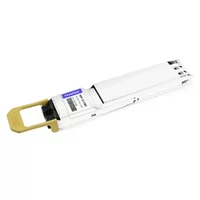
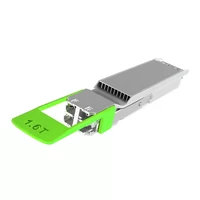
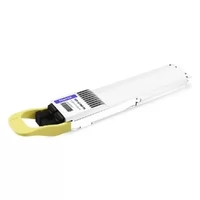
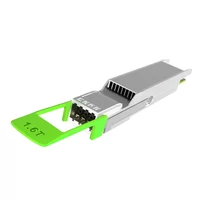
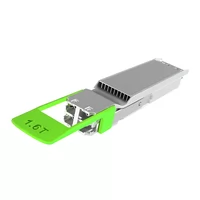
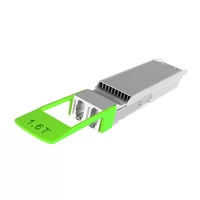
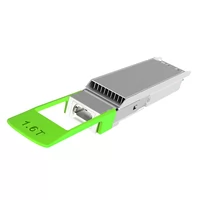
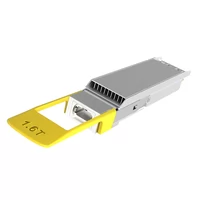
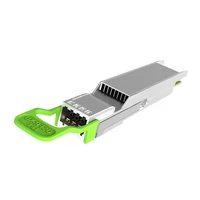
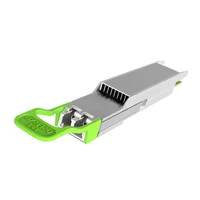
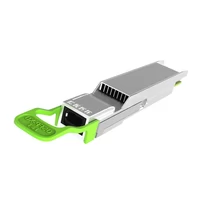
1.6T OSFP is an optical transceiver form factor delivering 1.6 Terabits per second—double the 800G standard—over eight electrical lanes running 200G PAM4 signaling each. It uses the same OSFP mechanical package as 400G and 800G modules but pushes electrical signaling to 224G SerDes speeds.
The specification emerged from the OSFP1600 MSA (Multi-Source Agreement) working alongside IEEE 802.3dj. Commercial availability started in 2025 with volume ramp expected through 2026–2027.
Key technical specifications:
| Parameter | 1.6T OSFP Spec |
| Electrical Interface | 8 × 224G PAM4 (OSFP224) |
| Total Bandwidth | 1.6 Tbps |
| Optical Channels | 8 lanes |
| Modulation | PAM4 (200G per lane optical) |
| Standard Power | 15–20W (standard OSFP) |
| OSFP-XD Power | Up to 33.5W |
| Reach Options | SR8, DR8, FR4, LR8 |
| Management | CMIS 5.2/5.3 |
Standard 1.6T OSFP modules fit existing OSFP cages. OSFP-XD variants require slightly larger cages for extended density and power handling.

OSFP vs OSFP-XD: What You Need to Know
The “XD” in OSFP-XD stands for “eXtended Density.” It’s a variant designed specifically for 1.6T and future 3.2T applications where standard OSFP thermal and electrical limits become constraints.
Standard OSFP at 1.6T:
- Uses 8 electrical lanes at 224G PAM4
- Fits existing OSFP cages
- Power envelope: 15–20W typical
- Suitable for short-reach applications (SR8, DR8)
OSFP-XD for 1.6T:
- Expands to 16 electrical lanes (8 used at 1.6T, 16 for 3.2T future)
- Larger heatsink for 33.5W+ power dissipation
- Requires OSFP-XD compatible cages (slightly longer)
- Better thermal performance for coherent optics (ZR/ZR+)
Marcus’s team learned this distinction the hard way. They ordered standard 1.6T OSFP modules for their Quantum-X800 switches, not realizing their planned ZR+ long-haul links required OSFP-XD variants. The modules physically fit, but thermal throttling started within minutes. They needed to replace half their order. See our OSFP Thermal Management Guide.
When to choose OSFP-XD:
- Long-haul coherent optics (FR4, LR8, ZR, ZR+)
- High-temperature environments
- Future-proofing for 3.2T migration
- Power-hungry DSP-based implementations
When standard OSFP works:
- Short-reach AI clusters (SR8, DR8)
- Controlled data center environments
- Existing OSFP cage infrastructure
- Lower power LPO/LRO implementations
400G vs 800G vs 1.6T OSFP Comparison
Understanding the progression helps with migration planning:
| Specification | 400G OSFP | 800G OSFP | 1.6T OSFP |
| Lane Speed | 50G PAM4 | 100G PAM4 | 224G PAM4 |
| Electrical Lanes | 8 lanes | 8 lanes | 8 lanes |
| Total Bandwidth | 400 Gbps | 800 Gbps | 1.6 Tbps |
| SerDes Generation | 56G/112G | 112G | 224G |
| Typical Power | 8–12W | 12–15W | 15–20W (33.5W OSFP-XD) |
| Maturity | Mature | Rapid adoption | Emerging (2025) |
| Primary Use | General data center | AI/ML training | Large-scale AI clusters |
The jump from 800G to 1.6T doubles bandwidth but keeps the same lane count. The real change is in SerDes technology—moving from 112G to 224G signaling. This pushes signal integrity requirements dramatically higher.
1.6T OSFP Module Types and Applications
Module variants follow the same naming convention as 400G and 800G:
| Type | Reach | Fiber | Connector | Use Case |
| SR8 | 100m OM4 / 150m OM5 | MMF | MPO-16 | AI cluster fabric |
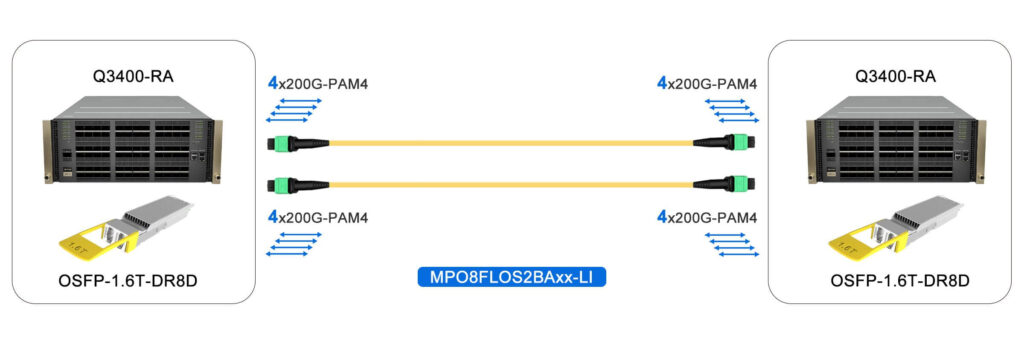
| DR8 | 500m | SMF | MPO-12/APC | Spine-leaf connections |
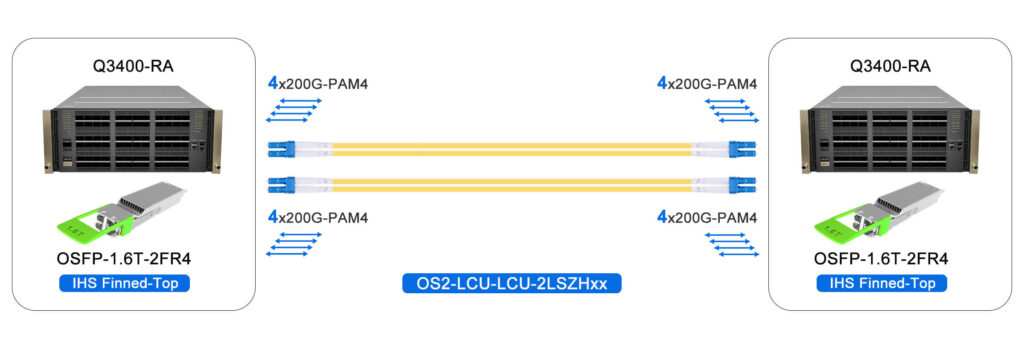
| 2×FR4 | 2km | SMF | Dual CS or LC | Metro DCI |
| 2×LR4 | 10km | SMF | Dual CS or LC | Campus interconnects |
| ZR/ZR+ | 80–480km | SMF | LC duplex | Long-haul coherent |
SR8 dominates AI training clusters. The 100m reach covers most modern data center fabrics, and MPO-16 connectors handle the eight optical lanes efficiently.
DR8 suits spine-to-spine or data center interconnects within a campus. The 500m reach and MPO-12 compatibility make it versatile.
2×FR4 and 2×LR4 split the 1.6T across two 800G FR4/LR4 optical engines. This enables longer reach but adds complexity and power.
ZR/ZR+ coherent variants handle metro and long-haul. These require the OSFP-XD form factor to support additional DSP power and thermal headroom.
Compatible Platforms and Switches
1.6T OSFP requires next-generation switching silicon. Current compatible platforms include:
| Vendor | Platform | Details |
| NVIDIA | Quantum-X800 XDR | 1.6T InfiniBand, 144 ports |
| NVIDIA | Spectrum-6 | 1.6T Ethernet switching |
| Broadcom | Tomahawk 6 | 102.4T switching ASIC |
| Cisco | Silicon One G300 | 25.6T–51.2T line cards |
| Celestica | DS6000/DS6001 | OCP-compliant 1.6T switches |
| Alpha Networks | 1.6T Liquid-Cooled | For extreme density |
NVIDIA drives most of the 1.6T demand. Their Quantum-X800 XDR switch delivers 144 ports of 1.6T InfiniBand—designed specifically for GPU clusters scaling to 100,000+ accelerators. Spectrum-6 brings equivalent speeds to Ethernet environments.
Broadcom’s Tomahawk 6 enables 1.6T from traditional networking vendors. Early switches using this ASIC started shipping in late 2025.
Critical compatibility note: Verify whether your platform supports standard OSFP or requires OSFP-XD. NVIDIA Quantum-X800 accepts both, but the cage dimensions differ. Check your specific switch model and line card revision.
Power and Thermal Planning
Power consumption scales significantly at 1.6T. Plan accordingly:
Per-module power estimates:
- Standard OSFP (SR8/DR8): 15–20W
- OSFP-XD (high-power): 25–33.5W
- Coherent ZR+: Up to 35W projected
Switch-level thermal math:
A 64-port 1.6T switch fully populated:
- Conservative: 64 × 18W × 2 ends = 2,304W for optics
- Plus switch ASIC power: 400–600W
- Total per switch: 2,700–2,900W
Compared to 400G: A similar configuration draws roughly 1,300–1,500W. 1.6T nearly doubles thermal density.
Infrastructure requirements:
- Front-to-back airflow: 4–5 m/s minimum
- Rack spacing: 8+ inches recommended (vs 6″ for 400G)
- Cooling: Liquid cooling becomes practical at this density
- Power per rack: Plan for 15–20kW per rack vs 8–12kW for 400G
Marcus’s team had to redesign their row cooling after initial deployment. The 1.6T switches overwhelmed their calculated loads within hours of full traffic testing.
800G to 1.6T Migration Strategy
Most organizations won’t migrate directly to native 1.6T everywhere. Phased approaches reduce risk:
Phase 1: Spine Layer (Months 1–3)
- Deploy 1.6T-capable spine switches
- Connect to existing 800G leaf switches via breakout
- Run parallel with existing infrastructure
Phase 2: Critical Leaf Upgrades (Months 4–6)
- Upgrade GPU/AI training leaf switches first
- Maintain 800G to legacy servers via breakout
- Monitor thermal and error rates closely
Phase 3: Full Native 1.6T (Months 7–12)
- Remove breakout cables once all endpoints support 1.6T
- Optimize for native end-to-end performance
- Retire the 800G infrastructure or repurpose to access layer
Breakout Considerations:
1.6T OSFP can break out to 2×800G or 4×400G, depending on module type:
- 1.6T DR8 → 2×800G DR4 (MPO-12 to dual MPO-12)
- 1.6T SR8 → 2×800G SR4 (MPO-16 to dual MPO-12)
This lets you deploy 1.6T spines while maintaining 800G leaf connectivity during transition.
Standards and Interoperability
1.6T OSFP operates under several standards:
OSFP1600 MSA
Defines mechanical, electrical, and thermal specifications for 1.6T modules. Revision 5.1 and later covers 1.6T operation.
IEEE 802.3dj
The 1.6 Terabit Ethernet Task Force specifies PHY layer requirements. Expected finalization in 2025–2026.
CMIS 5.2/5.3
Common Management Interface Specification for module monitoring and control. Required for 1.6T module management.
OIF CEI-224G
Electrical interface specification for 224G SerDes operation between host and module.
Interoperability notes:
- Modules from different vendors should interoperate at the optical level
- FEC modes must match on both ends (RS-FEC 544/514 required)
- CMIS version compatibility required for management features
- Thermal specifications vary—mixing vendors requires careful validation
Market Outlook and Timeline
2025: Commercial Debut
- Early production from Coherent, Marvell, Broadcom
- Limited volumes: ~20,000 units H1 2025
- Primarily NVIDIA GPU cluster deployments
- Prices 3–4× higher than equivalent 800G modules
2026: Volume Ramp
- Projected 30+ million units industry-wide
- Second-source vendors enter market
- Prices decline toward 2× 800G premium
- Broadcom Tomahawk 6 switches drive Ethernet adoption
2027: Mainstream Adoption
- 1.6T becomes default for new AI cluster builds
- 800G shifts to “budget” or legacy deployments
- OSFP-XD variants mature for long-haul coherent
2029–2030: 3.2T Transition
- OSFP-XD form factor enables 3.2T (16 lanes × 200G)
- Early adopters start pilot deployments
- 1.6T becomes the “workhorse” tier
Market drivers:
- NVIDIA: 60%+ of 1.6T demand (Spectrum-6, Vera Rubin Ultra)
- Hyperscalers: Google, Meta, Amazon, Microsoft, Alibaba, Tencent
- AI infrastructure: 100,000+ GPU clusters becoming standard
Deployment Checklist
Before ordering 1.6T OSFP hardware, verify:
Physical Compatibility
- Standard OSFP or OSFP-XD required?
- Switch cage dimensions confirmed
- Heatsink clearance verified
- Fiber connector types match (MPO-12 vs MPO-16 vs duplex)
Power and Thermal
- Per-module power budget: 15–33.5W planned
- Switch-level thermal calculations complete
- Rack cooling capacity verified
- Airflow direction confirmed (matches heatsink design)
Fiber Infrastructure
- OM4/OM5 for SR8 (<100m)
- OS2 single-mode for DR8/FR4/LR8
- MPO polarity Method B configured
- APC polish verified (not UPC)
- Insertion loss <0.35 dB per connection
Configuration
- FEC mode: RS-FEC 544/514 configured
- CMIS 5.2+ management enabled
- Pre-FEC BER threshold: <1×10⁻⁶
- 24-hour burn-in test planned
Migration Planning
- Breakout cable strategy defined
- Rollback plan if issues arise
- Spare modules ordered (10–15%)
- Vendor support contacts confirmed
Conclusion
1.6T OSFP represents the most significant speed transition in data center networking since 100G. It’s not an incremental upgrade—it’s a fundamental shift in how AI infrastructure scales. The technology works. The platforms exist. The question is whether your power, cooling, and budget are ready.
The key takeaways:
- Verify OSFP vs OSFP-XD requirements before ordering—thermal failures are expensive
- Plan for 2× the power density of 800G deployments
- Use breakout cables for phased migration
- Run 24-hour burn-in tests—1.6T is less forgiving of marginal fiber
- Monitor pre-FEC BER closely—marginal links fail faster at 224G
FiberMall supplies 1.6T OSFP modules in both standard and OSFP-XD form factors, with compatible MPO-12, MPO-16, and duplex fiber cabling. Contact our engineering team for platform compatibility verification or to request a quote for your AI infrastructure upgrade.
Related Products:
-
 NVIDIA MMS4A00 (980-9IAH1-00XM00) Compatible 1.6T 2 x DR4/DR8 OSFP224 PAM4 1311nm 500m IHS/Finned Top Dual MPO-12 SMF Optical Transceiver Module
$1500.00
NVIDIA MMS4A00 (980-9IAH1-00XM00) Compatible 1.6T 2 x DR4/DR8 OSFP224 PAM4 1311nm 500m IHS/Finned Top Dual MPO-12 SMF Optical Transceiver Module
$1500.00
-
NVIDIA MMS4X50-NM Compatible 1.6T 2xFR4/FR8 OSFP224 PAM4 1310nm 2km IHS/Finned Top Dual Duplex LC SMF Optical Transceiver Module
$1800.00
-
NVIDIA MMS4A00-RHS Compatible 1.6T 2xDR4/DR8 OSFP224 PAM4 1311nm 500m RHS/Flat Top Dual MPO-12/APC InfiniBand XDR SMF Optical Transceiver Module
$2000.00
-
OSFP-1.6T-4FR2 1.6T OSFP 4FR2 PAM4 1291/1311nm 2km SN SMF Optical Transceiver Module
$3500.00
-
OSFP-1.6T-2FR4 1.6T OSFP 2xFR4 PAM4 2x CWDM4 2km Dual Duplex LC SMF Optical Transceiver Module
$1800.00
-
OSFP-1.6T-DR8D+ 1.6T OSFP DR8D+ PAM4 1311nm 2km Dual MPO-12 SMF Optical Transceiver Module
$3500.00
-
OSFP-1.6T-DR8+ 1.6T OSFP DR8+ PAM4 1311nm 2km MPO-16 SMF Optical Transceiver Module
$3000.00
-
OSFP-1.6T-DR8D 1.6T 2 x DR4/DR8 OSFP224 PAM4 1311nm 500m Dual MPO-12 SMF Optical Transceiver Module
$1500.00
-
OSFP-1.6T-DR8 1.6T 2 x DR4/DR8 OSFP224 PAM4 1311nm 500m MPO-16 SMF Optical Transceiver Module
$3000.00
-
OSFP-XD-1.6T-4FR2 1.6T OSFP-XD 4xFR2 PAM4 1291/1311nm 2km SN SMF Optical Transceiver Module
$5000.00
-
OSFP-XD-1.6T-2FR4 1.6T OSFP-XD 2xFR4 PAM4 2x CWDM4 2km Dual Duplex LC SMF Optical Transceiver Module
$5000.00
-
OSFP-XD-1.6T-DR8 1.6T OSFP-XD DR8 PAM4 1311nm 2km MPO-16 SMF Optical Transceiver Module
$4500.00